July 3, 2026
Ask any optical importer in Kenya what keeps them up at night, and customs clearance usually comes up early in the conversation. Ophthalmic lenses fall under medical device regulations, and getting a shipment from a factory overseas onto an optician’s shelf in Nairobi, Kisumu, or Mombasa involves a regulatory process most patients never think about, and most opticians wish they didn’t have to.
As a lens manufacturer based in Kenya, we sit close enough to that process to know exactly how much friction it adds, because it’s the friction we built our facility to remove.
The Regulatory Chain Behind Every Imported Lens
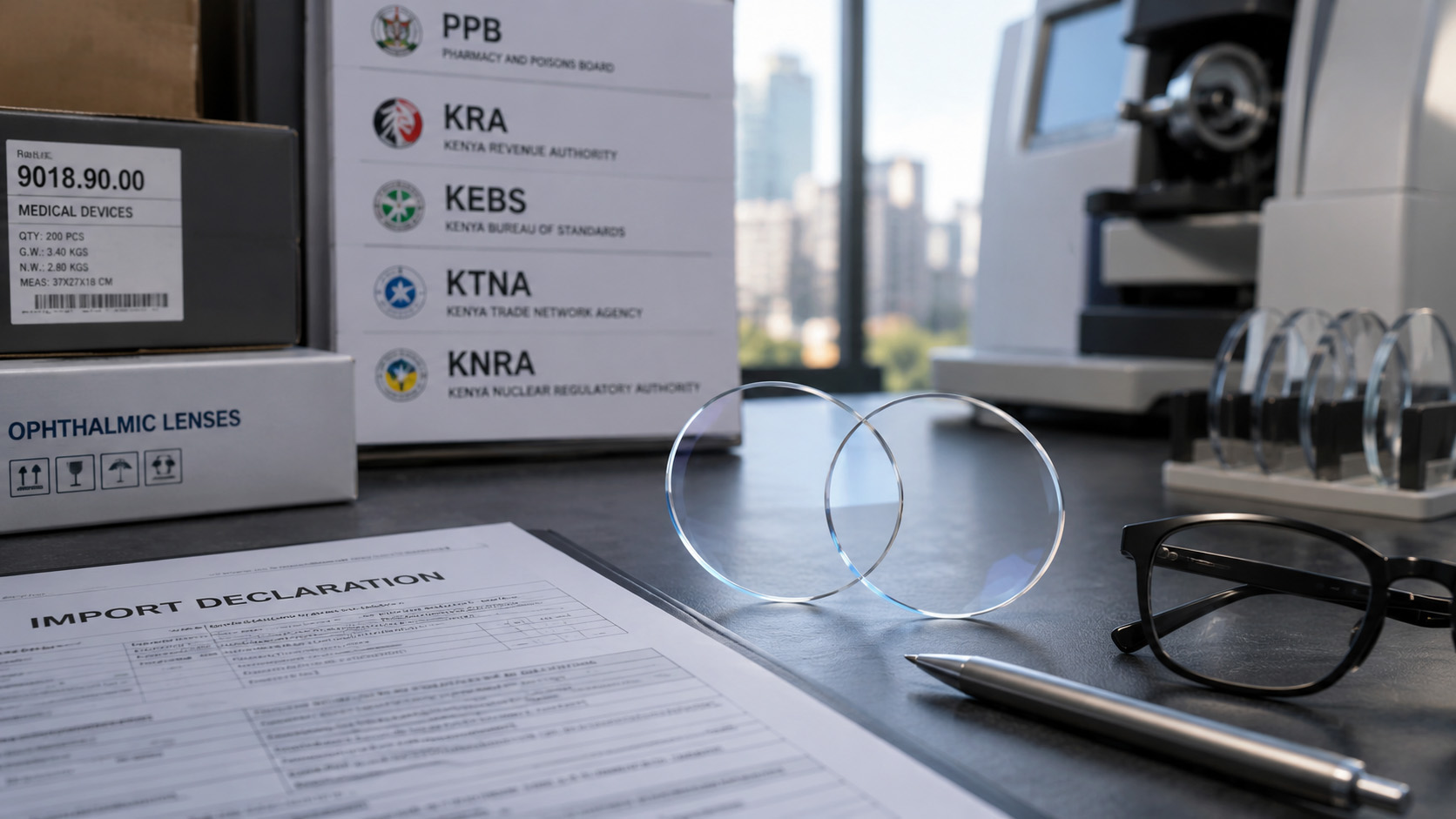
Any medical device entering Kenya, lenses included, has to clear a three-tier regulatory framework before it can legally reach a patient. Registration with the Pharmacy and Poisons Board comes first, and it’s non-negotiable. The PPB classifies the device, and that classification determines everything downstream, from the duty rate applied to the inspection protocol the shipment goes through.
From there, the Kenya Revenue Authority assigns an HS code (medical devices generally fall under the 9018 to 9022 range), and duty is charged at 0%, 10%, or 25% depending on how the device is classified under the EAC Common External Tariff. On top of that sits 16% VAT, a 2.25% Import Declaration Fee, and a 1.5% Railway Development Levy. None of these are optional, and none of them are small once you’re importing at volume.
Kenya Bureau of Standards adds a further layer, verifying that imported devices meet regional EAC standards and hold valid ISO certification, commonly ISO 13485 for the manufacturing facility itself. Kenya Trade Network Agency coordinates the electronic single-window system that ties PPB, KRA, and KEBS approvals together, and for any device involving radiation-emitting equipment, the Kenya Nuclear Regulatory Authority gets involved too. Five agencies, each with their own documentation requirements, all needing to align before a single lens crosses the border.
Why the Timeline Matters More Than People Realise
On paper, a well-prepared shipment can clear Jomo Kenyatta International Airport in two to five business days, or Mombasa Port in five to ten. In practice, the full journey from PPB registration to cargo collection at the warehouse door typically runs ten to fourteen weeks, and that’s the smooth version. Missing documentation, an incorrect HS code, or a PPB classification still pending approval can stretch port dwell time out to fifteen to twenty-one days on its own, with storage costs accumulating the entire time.
For an optician waiting on stock, that isn’t an abstract logistics statistic. It’s a patient told to come back next month for a lens that, technically, already exists somewhere in a shipping container. Multiply that delay across every optician in the country sourcing lenses from overseas, and the cumulative effect on how quickly Kenyans can actually get corrective lenses becomes significant.
Local Manufacturing Sidesteps the Chain Entirely
This is the part of the story that doesn’t usually get told alongside the customs statistics, because it’s rarely relevant to a freight and clearing conversation. It becomes very relevant, though, once you’re the one waiting on the lens.
Afrilens was established as East Africa’s first advanced ophthalmic lens manufacturing facility specifically to shorten this chain. A lens produced at our facility in Kenya, for the Kenyan market, never has to clear PPB import registration, wait on an HS code assessment, or sit in port storage accumulating demurrage. It doesn’t carry the layered cost of import duty, VAT on the CIF value, IDF, and RDL stacked on top of international freight. It also doesn’t depend on vessel scheduling out of a foreign port or air freight capacity into JKIA.
None of this is a criticism of the importers and clearing agents doing careful, professional work within that system. Kenya’s medical device import framework exists for good reasons, protecting patients from substandard or unverified devices entering the market. The point is simply that when the manufacturing itself happens locally, an entire layer of cost, time, and risk disappears from the equation before it ever has the chance to affect an optician’s shelf.
What This Means for the Opticians We Work With
In practical terms, it means we can hold ready stock across our core product ranges without the six-to-ten-week supply chain anxiety that comes with importing from overseas. It means pricing that reflects a shorter, local production chain rather than duty, VAT, and international shipping stacked on top of manufacturing cost. And it means an optician placing an order with us isn’t gambling on whether a shipment clears Mombasa Port on schedule or gets flagged for additional inspection.
Built in partnership with Schneider Optical technology, our lenses are manufactured to the same precision standards patients would expect from an imported alternative. The difference is what happens after the lens leaves the production line. Instead of a customs queue, an HS code review, and a multi-agency approval chain, it goes straight to the optician who ordered it.
Kenya’s eye care access gap has been well documented recently, with government figures putting effective refractive error coverage at just 6.7% of the population. Closing that gap will take investment across training, primary healthcare integration, and affordability, and no single piece of the supply chain solves it alone. But a shorter, more reliable path from lens production to patient is one part of that solution that local manufacturing is uniquely positioned to deliver, without a single shipment ever needing to clear customs at all.
Afrilens is East Africa’s first advanced ophthalmic lens manufacturing facility, built in partnership with Schneider Optical technology. We currently supply independent opticians, retail chains, hospitals, and NGOs across Kenya, with plans to expand across East and Central Africa in the coming years.